
Flooring in Porto
Laminate, solid wood, vinyl, tile and microcement — with the levelling done first, because that is what decides whether a floor lasts.
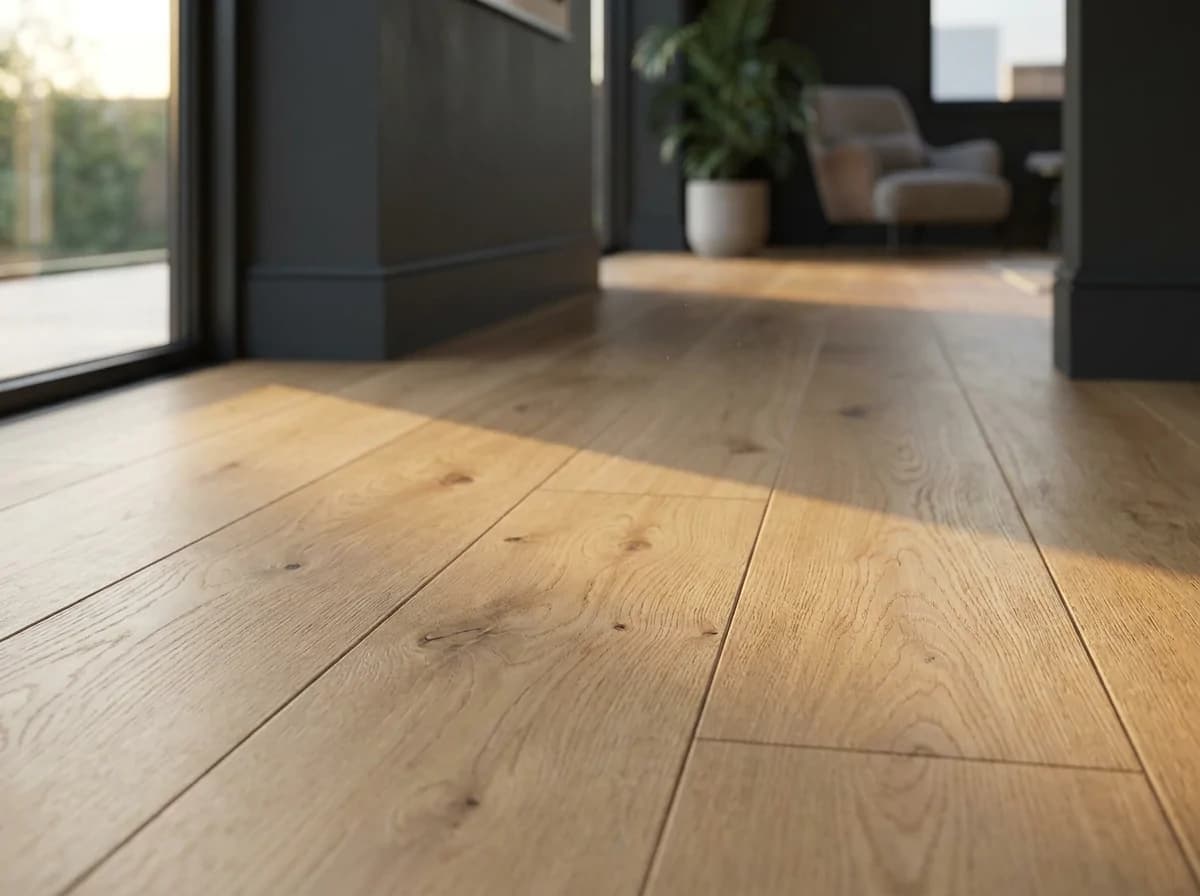
What does fitting a floor include?
- Laminate and solid wood
- Vinyl and tile
- Microcement
- Levelling and subfloor preparation
Where we work
We are based in Rio Tinto, Gondomar, and work across Porto, Gondomar, Vila Nova de Gaia, Matosinhos and nearby areas. For other locations, contact us to confirm availability and the conditions of a site visit.
Laminate and solid wood
A laminate floor sits on an underlay rather than being glued down, which makes it quick to lay and possible to replace later; solid wood is glued or nailed, lasts far longer and can be sanded back when the years begin to show. Choosing between the two is rarely a matter of taste alone: how much traffic the home takes, whether there is underfloor heating, how damp the room is and the budget available all weigh in. We explain the difference with the samples in front of you, before anything is bought, and not once the material is already on site.
Vinyl and tile
Vinyl solves wet rooms and homes with children or pets: it is warm underfoot, quiet and unbothered by water. Ceramic and porcelain are still the choice for kitchens, bathrooms and outdoor areas, and there the work is in the laying — alignment, level, cutting around thresholds and the choice of grout. A well-laid tiled floor shows in the edges and the corners, not in the middle of the room. Either way, who supplies the material is written into the quote: it can be us or it can be the client.
Microcement
Microcement gives a continuous surface with no joints, which is why it keeps appearing in renovations in Porto — on floors, but also on walls and worktops. It is also the covering that forgives the least: it goes on in layers, each with its own drying time, over a base that is sound and stable. If the base moves, the microcement cracks, and the repair never becomes invisible. So we treat the preparation as part of the job rather than as an extra, and we say from the outset when an existing floor is not in a fit state to take it.
Levelling and subfloor preparation
Levelling is the part nobody sees and the part that decides everything else. Before anything is laid we check how flat the base is, correct the falls with screed or self-levelling compound and check the moisture — laying wood over a base that is still damp guarantees the floor will lift. It also covers the skirting boards, the thresholds and the expansion gaps at the walls, which are what let the material move without buckling. It is invisible work on the first day, and it is the work you notice in year five.
Which floor should you choose for each room?
No single floor is better than the rest; there is the one that suits each room. In wet areas — bathrooms, kitchens, utility rooms — ceramic, porcelain and vinyl are the safe options, because water does not degrade them. In living rooms and bedrooms, solid wood and laminate give warmth underfoot and a quieter room, and solid wood has the advantage that it can be sanded back rather than replaced. Microcement suits anyone who wants a continuous surface and works with underfloor heating, as long as the base is in condition. Outdoors, what governs the choice is resistance to frost and how the surface behaves when wet. Continuity counts too: changing material at every doorway breaks up a small home visually. At the site visit we look at the rooms, measure and tell you what works in each, with a written quote, free and without obligation.
What makes the price of a floor vary?
In the estimator on this site, flooring appears between €28 and €70/m², VAT included. It is a wide range because, with a floor, the material is only part of the bill:
- The material chosen. Between a standard laminate, a solid wood floor and microcement lies the biggest difference in the whole quote.
- The state of the base. A flat, dry slab takes the floor straight away; a base with falls, with damp or with an old covering to lift means work before the work.
- The area and the laying pattern. Small, broken-up rooms mean more cutting and more waste per square metre than one open room, and patterns such as herringbone add labour.
- The finishing details. Skirting boards, thresholds, transition strips and easing the doors that no longer close once the floor level has risen.
The estimator figure is indicative. To find out what your floor costs, request the free quote: we measure the area, look at the base and give you a written price, with no obligation.
How we get started
- 01
Tell us what you have in mind — by phone, on WhatsApp or through the form.
- 02
We come to you, take the measurements and listen to what you want. The site visit is free in Porto and neighbouring municipalities.
- 03
You get a written quote, free and with no obligation, setting out who supplies what.
Shall we talk about your project?
Describe the work you have in mind and we will tell you whether it is for us, what it costs and when it can start.
Other specialities
- ConstructionNew builds, extensions and structural work. From permits and foundations through to finishes.
- RenovationFull or partial refurbishment of apartments, houses and commercial spaces.
- PaintingInterior and exterior, surface preparation, plastering and decorative finishes.
- Drywall & False CeilingsPartitions, suspended ceilings, coving, and acoustic and thermal insulation.
- Small worksRepairs, adjustments and one-off jobs. No job is too small.
- 3D DesignSee your space before the work starts. Decide with confidence.