
Plasterboard and suspended ceilings in Porto
Partitions, suspended ceilings, coving and insulation — to change a home's layout without touching its structure.
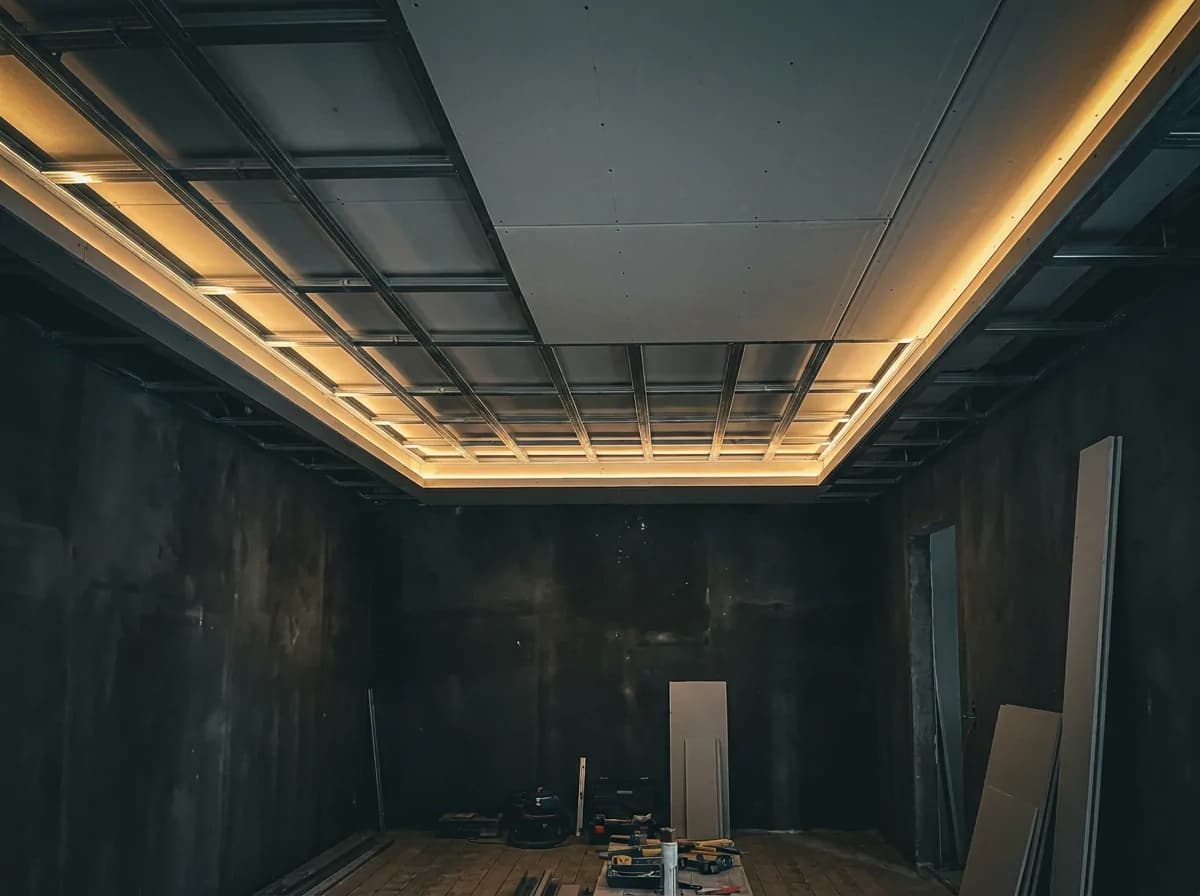
What does plasterboard and suspended ceiling work include?
- Plasterboard partitions
- Suspended ceilings and coving
- Acoustic insulation
- Thermal insulation
Where we work
We are based in Rio Tinto, Gondomar, and work across Porto, Gondomar, Vila Nova de Gaia, Matosinhos and nearby areas. For other locations, contact us to confirm availability and the conditions of a site visit.
Plasterboard partitions
A plasterboard partition is built on a metal frame, closed on both sides with boards and filled with mineral wool. It is the cleanest way to change the layout of a home: it goes up in days, weighs a fraction of a brick wall and lets plumbing and wiring run inside it without chasing out the masonry. In wet rooms, moisture-resistant boards are used and, where the use demands it, fire-resistant ones. When a unit or a television has to be hung, the reinforcement is planned into the frame — once the wall is closed, there is no way back.
Suspended ceilings and coving
A suspended ceiling solves two problems at once: it hides the pipework, ducts and cabling that would otherwise be on show, and it corrects an uneven ceiling. It is also what allows recessed lighting and coving with indirect light, which completely change the way a room reads at the end of the day. The height you give up is decided at the start, according to what runs above it, and it is not recovered later. We mark out the light positions with the client before closing up, because moving a downlight once the boards are fixed means opening, filling and painting all over again.
Acoustic insulation
Noise between rooms and between neighbours is rarely solved by one more board. It is solved by three things together: mineral wool inside the frame, enough mass in the boards and, above all, breaking the rigid contact that carries the vibration from one side to the other. In an older flat in Porto, an acoustic lining on a party wall is often what makes a bedroom liveable. We say plainly what a solution can achieve and what it cannot before quoting it — in acoustics, promising silence is easy and untrue.
Thermal insulation
The same system serves to insulate against cold and heat. An insulated lining applied from the inside is the intervention available when the façade cannot be touched — in buildings with a protected frontage, or when the residents' association will not follow. You gain comfort and reduce the condensation that brings mould to the corners of external walls, provided the thermal bridges are dealt with and the home goes on being ventilated. You lose a few centimetres of space on every wall treated, and that is said beforehand, with the measurements to hand.
Plasterboard or a brick wall — which should you choose?
It depends on what the wall has to do. To divide space inside a home, plasterboard wins almost every time: it goes up far quicker, makes less mess, puts less weight on the slab — which counts in older buildings — and carries the services inside it, with no chasing out of masonry. With mineral wool and the right board thickness, its acoustic performance is comparable to that of a single-skin brick wall. Brick still makes sense where the wall has a structural job, in outdoor areas and where permanent heavy loads are expected. The most common worry — hanging things on it — is solved with reinforcements fixed into the frame before it is closed, as long as you know in advance where they need to be. At the site visit we look at the layout, listen to what you want and tell you which of the solutions suits, with no obligation.
What makes the price of plasterboard work vary?
The estimator on this site has no separate line for plasterboard: within a renovation, this work sits inside the square-metre figure for the job. When it is quoted on its own, the price is formed like this:
- The type of board. A standard board, a moisture-resistant one for wet rooms and a fire-resistant one do not cost the same, and the choice is not always free.
- The insulation asked for. The thickness of the mineral wool and the acoustic or thermal solution adopted change both the material and the time it takes to build.
- The design of the ceiling. A flat ceiling is one job; coving, changes of level, curves and boxing for blinds or curtain tracks are another.
- The finishing and what comes next. Taping, filling, sanding and leaving the surface ready to paint is part of the work, and there is always the decision whether to include the painting itself.
Request the free quote: we measure the run of the walls and the ceilings and give you a written price, with no obligation.
How we get started
- 01
Tell us what you have in mind — by phone, on WhatsApp or through the form.
- 02
We come to you, take the measurements and listen to what you want. The site visit is free in Porto and neighbouring municipalities.
- 03
You get a written quote, free and with no obligation, setting out who supplies what.
Shall we talk about your project?
Describe the work you have in mind and we will tell you whether it is for us, what it costs and when it can start.
Other specialities
- ConstructionNew builds, extensions and structural work. From permits and foundations through to finishes.
- RenovationFull or partial refurbishment of apartments, houses and commercial spaces.
- FlooringLaminate, solid wood, vinyl, tile and microcement with professional levelling.
- PaintingInterior and exterior, surface preparation, plastering and decorative finishes.
- Small worksRepairs, adjustments and one-off jobs. No job is too small.
- 3D DesignSee your space before the work starts. Decide with confidence.